ProductXplorer
Strategic Foundation
Orchestrates your full strategic foundation: ICPs, personas, feature list, and glossary — from a single conversation.
Conntinuum gives your team product development team a full roster of specialized AI agents — we call them Splines — each trained on a specific discipline of the software development lifecycle. They work alongside your product managers, engineers, designers, and testers to plan, specify, architect, build, test, and ship your product. Every phase. Every deliverable. One continuous thread.
Spec Driven Development
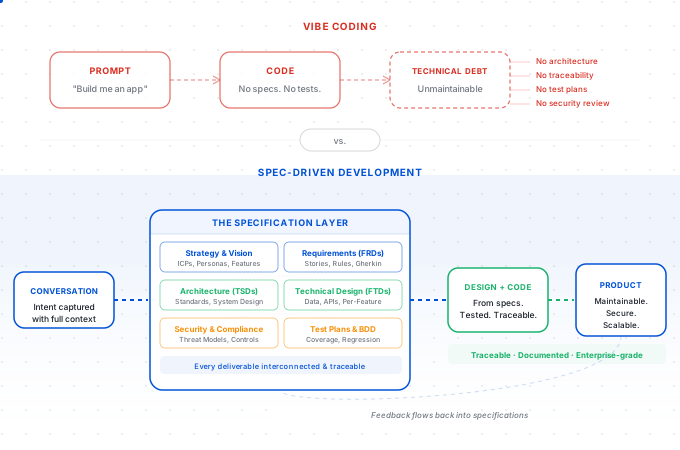
Vibe coding tools start with a prompt and go straight to code. No specifications. No architecture. No test plans. No traceability. The result is software that works on Tuesday and breaks on Friday.
Conntinuum takes a fundamentally different approach. Every product starts with a specification — a complete, interconnected document layer built by our C3V methodology and BDD process that covers strategy, requirements, architecture, security, and testing. Code is generated from those specifications, not instead of them.
That specification layer is what makes Conntinuum’s output maintainable, secure, testable, and scalable. It’s what lets your engineers understand why something was built. It’s what lets your QA team trace every test to a requirement. And it’s what vibe-coded software will never have.
THE TEAM
Every Spline is a specialist. Each one is trained on a specific discipline of software development and works within the context of your product — its strategy, its architecture, its decisions, and its constraints. They don’t replace your team. They make your team faster, more thorough, and more aligned.
Below you can see how our Splines align to your Product Team.
Conntinuum is built on Behavior Driven Development (BDD) because its focus on shared understanding, concrete examples, and traceable behavior maps naturally to an agentic software platform: many specialized agents need a common language, clear intent, and continuous alignment across disciplines.
The “Three Amigos” team — Product, Architecture, and QA — is a well-known expression of that mindset: before code, those perspectives stay in the same conversation so requirements, design, and quality criteria reinforce each other instead of drifting into silos.
Our Leadership / Orchestrator Splines (ProductXplorer, ArchitectXplorer, and TestXplorer) serve that role in Conntinuum. Each orchestrates a pipeline of specialist Splines, keeping product strategy, technical design, and quality assurance woven through every deliverable from the start.
Orchestrates your full strategic foundation — vision, ICPs, personas, features, and glossary. The Product perspective ensures every deliverable traces to user value and business intent.
Orchestrates the full architecture pipeline: TSD, system design, data models, API specs, security requirements, and infrastructure specs.
Orchestrates the full testing pipeline: strategy, functional tests, API tests, security, accessibility, performance, automation, and regression.
Strategic Foundation
Intake & Vision
Feature Requirements
Generates complete feature requirement documents with user stories, business rules, acceptance criteria, and executable Gherkin statements.
Backlog Management
Maintains a centralized user story registry across all FRDs with planning metadata, status tracking, and GitHub sync.
System Architecture
Orchestrates the full architecture pipeline: TSD, system design, data models, API specs, security requirements, and infrastructure specs.
Feature Technical Design
Produces per-feature technical designs: API endpoints, data model changes, security considerations, and implementation guidance.
Data Architecture
Designs entity relationships, database schemas, data dictionaries, and migration strategies aligned with your domain model.
API Controls
Generates OpenAPI-compatible endpoint definitions, request/response schemas, authentication patterns, and versioning strategies.
Design Specification
Orchestrates the design pipeline: design system, user flows, screen specs, interaction patterns, and accessibility audits.
Screen Specifications
Produces implementation-ready screen specs: layout, component placement, states, validation rules, and responsive behavior.
Interaction Patterns
Defines state machines, transitions, micro-interactions, loading patterns, and form submission flows for every screen.
Design System
Produces your component catalog, design tokens, pattern library, and responsive grid foundations.
User Journeys & Flows
Produces experience-level user journeys and critical product flows that inform every downstream specification.
Test Orchestration
Orchestrates the full testing pipeline: strategy, functional tests, API tests, security, accessibility, performance, automation, and regression.
Functional Test Cases
Generates detailed test cases from FRD rules and Gherkin statements with full traceability and coverage gap analysis.
Security Testing
Produces OWASP Top 10 scenarios, auth/authz tests, input validation tests, and compliance checklists.
Accessibility Testing
Generates WCAG 2.1/2.2 test cases, screen reader scenarios, keyboard navigation tests, and assistive tech compatibility matrices.
Performing Testing
Defines load profiles, stress scenarios, SLA thresholds, soak tests, and capacity planning recommendations.
Security Requirements
Generates threat models, security controls, auth architecture, encryption requirements, and compliance framework mappings.
Infrastructure & DevOps
Specifies deployment architecture, CI/CD pipelines, monitoring, disaster recovery, and scaling strategies.
System Architecture
Designs service boundaries, technology stack selection, architectural patterns, and scalability approach.
Project Governance
Bootstraps and maintains assumption registries, decision logs, open questions, and documentation structure.
Regression & Release Readiness
Defines regression suites, smoke tests, change impact analysis, and release readiness checklists with measurable gates.
A NEW WAY TO BUILD
Conntinuum doesn’t just add AI to your existing process. It transforms how every person on your team does their job — from how product managers capture intent to how engineers access specifications to how QA engineers trace coverage.
| Role | Today | With Conntinuum | Impact |
|---|---|---|---|
| Product Manager | Spends 3–5 days writing PRDs from scratch in Google Docs. Copies them into Confluence, where they’re immediately outdated and never read again. Stakeholder alignment requires three rounds of meetings, two follow-up Slack threads, and a passive-aggressive email chain before everyone agrees on something that changes again next sprint. |
Has a conversation with SparkXplorer. A structured Vision Board, ICPs, user personas, and a prioritized feature list emerge from that conversation. Updates propagate automatically across every connected deliverable. No Confluence page required. |
3X more product capacity per PM 80% reduction in time spent creating specs 0 documentation drift |
| Software Engineer | Opens a Jira ticket with two sentences of context and an acceptance criteria that says “user can log in.” Spends 30% of sprint time asking clarifying questions in Slack, but gets ignored by everyone except the product manager trainee who just came back from a week of vacation, missed all the meetings, and provides out-of-date answers. Discovers mid-build that the spec was updated last Tuesday and nobody told the team. |
Opens the feature in Conntinuum and sees the full FRD: user stories, business rules, acceptance criteria, Gherkin statements, architecture decisions, and data model — all traceable to the original product intent. Fires up the CodeXplorer Splines and puts them to work building the feature. |
3 - 4x feature throughput per sprint 85% reduction in time clarifying requirements 0 context-switching costs when moving between tasks |
| Designer | Gets a brief that says “make it intuitive.” Guesses at interaction states and edge cases. Delivers wireframes in Figma, then discovers in QA that three error states were never accounted for. Accessibility is an afterthought bolted on two days before launch. Back to Figma. 🤷 |
DesignXplorer generates screen specs, interaction state machines, and WCAG accessibility audits directly from the FRD. Every screen traces back to a user story. Every state is accounted for. Figma gets fed specifications instead of guesses. |
70% fewer revision cycles 4x design surface area per designer 100% decrease in guessing about requirements |
| QA Engineer | Gets pulled into feature planning the day before the sprint ends. Writes test cases from specs so vague they could describe three different features. Discovers edge cases during testing that should have been caught in requirements. Ships anyway because the release date doesn’t move. Nobody checks if the tests are passing. Nobody checks if there are tests. |
TestXplorer produces comprehensive test cases, API contract tests, security scenarios, and accessibility audits — all traceable to specific FRD rules and Gherkin statements. Tests execute automatically after every commit and the plan is updated immediately by TestPlanXplorer. Coverage gaps are surfaced before a single line of code is written. |
15 minutes to build & validate test plans 100% test traceability to requirements 0 "did anyone check the tests?" moments |
| CTO | Architecture decisions live in someone’s head — and that someone left six months ago. Technical debt accumulates because the team moves too fast to document anything. New hires take weeks to understand why anything was built the way it was. The answer is usually “nobody knows.” Proceeds to lose all remaining hair. |
ArchitectXplorer produces the TSD, system design, data model, API contracts, security requirements, and infrastructure spec — all validated against each other. Every decision has a rationale. Every standard is documented. New hires are fully productive in hours, not weeks. |
100% architecture decision documention 0 undocumented tribal knowledge 80% faster team-member onboarding |
| Project Manager | Maintains a spreadsheet of user stories manually, because he used Microsoft Project at his last job but this company uses Asana — and it doesn’t matter anyway because nobody else on the team even has a license. Status updates require chasing five people across Slack, Jira, and email. Release readiness is a gut feeling, not a measurable gate. |
PjMXplorer generates phased roadmaps and sprint plans from the feature list. The user story registry auto-updates when FRDs change. Release readiness checklists have measurable, objective criteria. One tool. One source of truth. |
90% less time gathering status updates 4x increase in project capacity, per PjM 0 minutes time to update and disseminate project updates |
Spends 3–5 days writing PRDs from scratch in Google Docs. Copies them into Confluence, where they’re immediately outdated and never read again. Stakeholder alignment requires three rounds of meetings, two follow-up Slack threads, and a passive-aggressive email chain before everyone agrees on something that changes again next sprint.
Has a conversation with SparkXplorer. A structured Vision Board, ICPs, user personas, and a prioritized feature list emerge from that conversation. Updates propagate automatically across every connected deliverable. No Confluence page required.
Opens a Jira ticket with two sentences of context and an acceptance criteria that says “user can log in.” Spends 30% of sprint time asking clarifying questions in Slack, but gets ignored by everyone except the product manager trainee who just came back from a week of vacation, missed all the meetings, and provides out-of-date answers. Discovers mid-build that the spec was updated last Tuesday and nobody told the team.
Opens the feature in Conntinuum and sees the full FRD: user stories, business rules, acceptance criteria, Gherkin statements, architecture decisions, and data model — all traceable to the original product intent. Fires up the CodeXplorer Splines and puts them to work building the feature.
Gets a brief that says “make it intuitive.” Guesses at interaction states and edge cases. Delivers wireframes in Figma, then discovers in QA that three error states were never accounted for. Accessibility is an afterthought bolted on two days before launch. Back to Figma. 🤷
DesignXplorer generates screen specs, interaction state machines, and WCAG accessibility audits directly from the FRD. Every screen traces back to a user story. Every state is accounted for. Figma gets fed specifications instead of guesses.
Gets pulled into feature planning the day before the sprint ends. Writes test cases from specs so vague they could describe three different features. Discovers edge cases during testing that should have been caught in requirements. Ships anyway because the release date doesn’t move. Nobody checks if the tests are passing. Nobody checks if there are tests.
TestXplorer produces comprehensive test cases, API contract tests, security scenarios, and accessibility audits — all traceable to specific FRD rules and Gherkin statements. Tests execute automatically after every commit and the plan is updated immediately by TestPlanXplorer. Coverage gaps are surfaced before a single line of code is written.
Architecture decisions live in someone’s head — and that someone left six months ago. Technical debt accumulates because the team moves too fast to document anything. New hires take weeks to understand why anything was built the way it was. The answer is usually “nobody knows.” Proceeds to lose all remaining hair.
ArchitectXplorer produces the TSD, system design, data model, API contracts, security requirements, and infrastructure spec — all validated against each other. Every decision has a rationale. Every standard is documented. New hires are fully productive in hours, not weeks.
Maintains a spreadsheet of user stories manually, because he used Microsoft Project at his last job but this company uses Asana — and it doesn’t matter anyway because nobody else on the team even has a license. Status updates require chasing five people across Slack, Jira, and email. Release readiness is a gut feeling, not a measurable gate.
PjMXplorer generates phased roadmaps and sprint plans from the feature list. The user story registry auto-updates when FRDs change. Release readiness checklists have measurable, objective criteria. One tool. One source of truth.
How Conntinuum Works
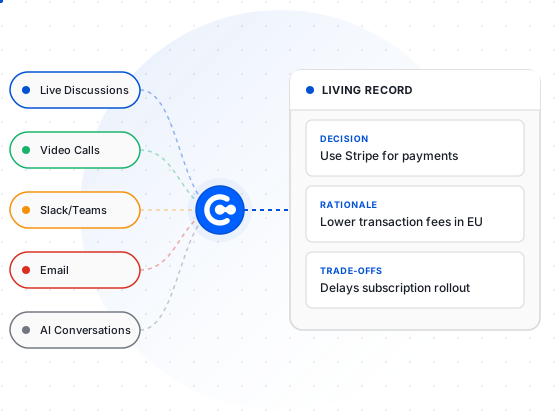
Your product vision starts in a conversation — a conference room decision, a Slack thread, a Zoom call, while you're out for an early morning run.
Conntinuum’s Splines — our specialized AI agents — show up wherever your team works and do far more than take notes. They ask the questions nobody thought to ask. They capture not just what was envisioned, decided, or debated, but why.
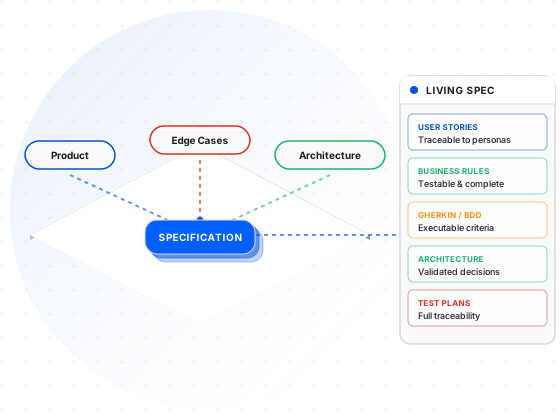
This is where Conntinuum diverges from every other tool on the market. From captured intent, your Splines produce a complete specification layer — feature requirements with testable business rules and executable Gherkin, system architecture validated against technical standards, data models, API contracts, security threat models, and comprehensive test plans. Every deliverable is interconnected. Every requirement is traceable. Every change propagates automatically.
This is Spec-Driven Development. The specification isn’t documentation you write after the fact. It’s the artifact your product is built from.
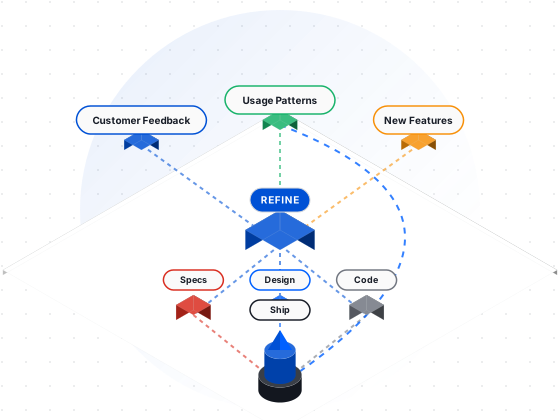
From living specifications, Conntinuum generates code, orchestrates builds, and coordinates deployments — all grounded in the spec layer your Splines have been building since day one. Engineers aren’t working from prompts. They’re working from complete, validated specifications that tell them what to build, why it matters, and how it connects to everything else in the product.
But deployment isn’t the finish line — it’s where the feedback loop begins. Customer feedback, usage patterns, and new strategic decisions feed back into the specifications. Your product doesn’t just ship. It compounds.
Experience SparkXplorer
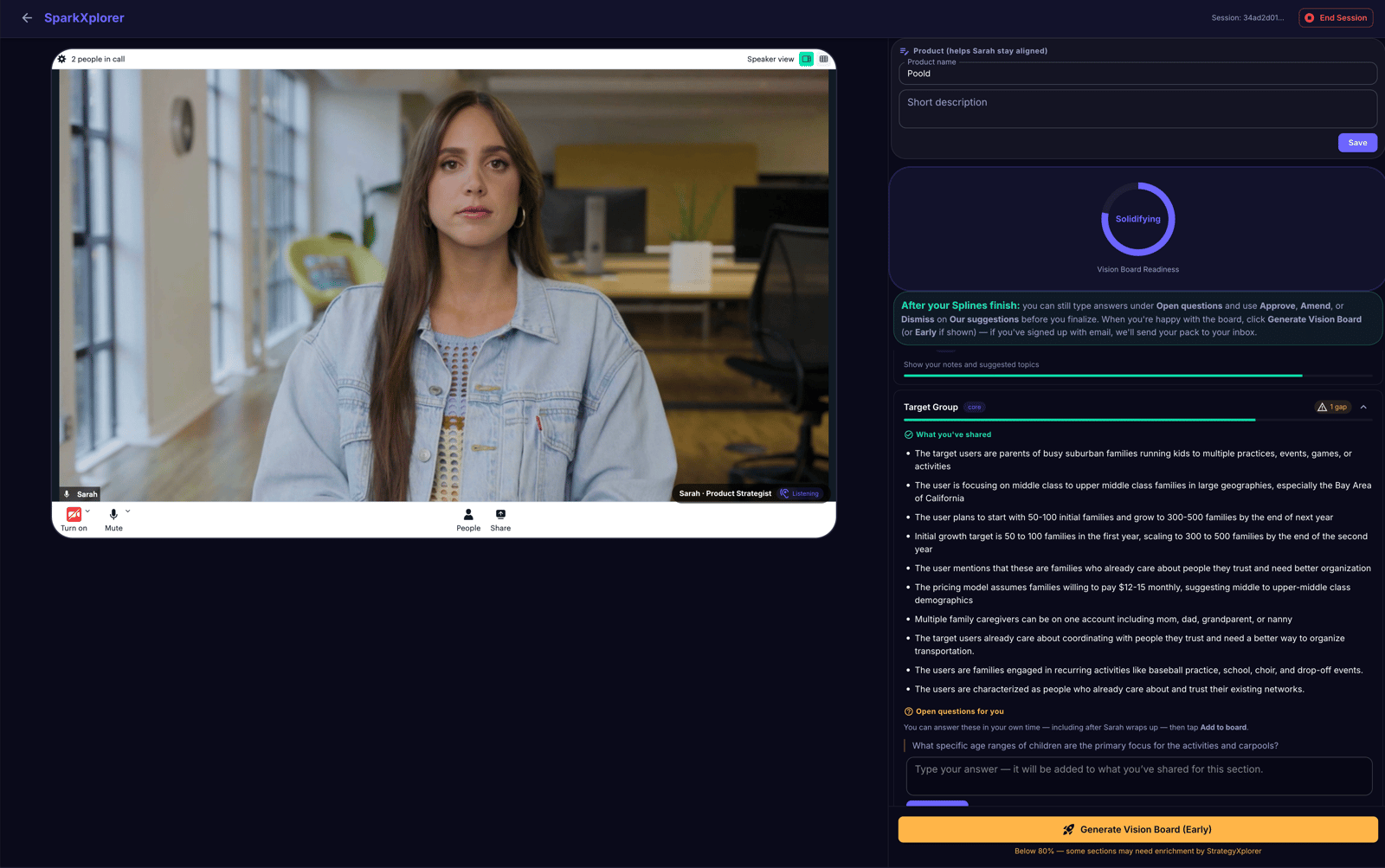
SparkXplorer is where your product journey with Conntinuum begins. Tell one of our AI product managers about what you’re building — a new product, an internal tool, a business automation, or a legacy modernization — and they’ll ask the right questions, surface blind spots, and deliver a structured Vision Board in a single session.
It's not a demo. It's the first real step toward shipping your product.
Results in about 10 minutes.
What's in a name?
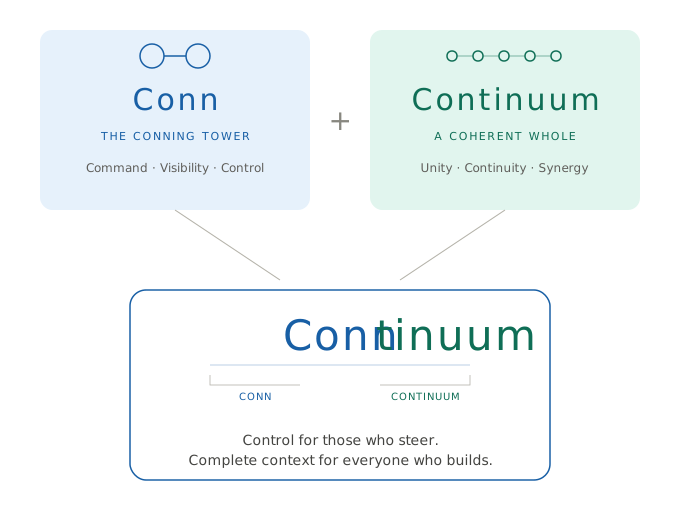
"Conn" comes from the conning tower — the raised platform from which an officer controls a vessel and maintains visibility of everything in motion. In product development, that kind of control rarely exists. Decisions get made in rooms, on calls, in threads — and by the time they reach the people building the product, the intent behind them is already distorted.
A continuum is a collection of distinct parts operating as a coherent whole — each element doing what it does best, the sum greater than its parts.
Conntinuum is both. It gives every leader, every team, and every stakeholder the visibility and control they need — while ensuring the whole organization moves as one.